

In June 2026, South Korea achieved what would have seemed unimaginable a decade ago: monthly exports surpassed USD 100 billion for the first time, rising 70.9% year-on-year. This surge was driven by semiconductors and “Solid-State Drives” (SSD) — fast computer storage devices — accounting for over 80% of information and communications technology (ICT) exports. The ICT sector alone surpassed half of total exports for the first time in the country’s history. In 2025, total exports had already reached a record USD 709.7 billion, the largest trade surplus at that time since 2017. This was mainly driven by AI memory chip demand that currently only South Korea can supply at scale. Despite these tremendous figures, the environment that enabled the South Korean export-led miracle is changing. Open global trade, a complementary relationship with China, and unchallenged dominance in memory chips are increasingly being tested as the trend of de-globalisation continues. South Korea today stands at a cross-road of future defining strategic choices. Either to remain an export nation dependent on chip volumes and market access, or transform itself into an ecosystem power that shapes critical industries’ global supply chains from the inside, especially AI and technology. The country’s response to this challenge suggests that it is attempting to pursue both choices simultaneously. In this article, we delve into the strategic choices more deeply.
The foundation of South Korea’s export success is its unrivalled position in the global memory chip industry. Samsung Electronics and SK Hynix together control approximately 73% of the global market for the high-speed memory chips that power computers, smartphones, and the large data centres underpinning artificial intelligence (AI). As the world’s largest technology companies race to build AI infrastructure, demand for South Korean chips has surged at a pace no other country can match. Yet this concentration of success carries its own risks. South Korea’s export engine is heavily dependent on a single product category at a moment when the global trade environment is becoming less predictable. More critically, China, South Korea’s largest and most profitable export market for decades, is no longer the partner it once was. Chinese industrial policy has systematically built domestic alternatives to South Korean products across electronics, electric vehicles and batteries. The result is stark: South Korea’s annual trade surplus with China decreased significantly from nearly USD 100 billion in 2018 to just USD 20 billion in 2025. A country that built its prosperity on open global trade now finds itself increasingly vulnerable to the shifting priorities of its two most important partners.
South Korea’s response to this evolution has been to deepen its strategic partnership with the United States as an alternative, culminating at the beginning of 2026 in a landmark trade and security agreement that reshapes the bilateral relationship more fundamentally than any deal since the two countries signed their free trade agreement in 2012. Under the terms of the deal, American tariffs on South Korean goods were reduced from 25% to 15%, providing meaningful relief for South Korean exporters. In return, South Korea pledged to invest USD 350 billion in the United States, including USD 150 billion in the American shipbuilding industry, the largest outward investment commitment in South Korean history. The agreement also grants South Korea approval to build nuclear-powered submarines, a capability Seoul has pursued for years and views as essential for its long-term security. The deal embeds South Korea firmly within the American-led industrial and security ecosystem, signalling a clear strategic choice in the face of Chinese pressure. However, it comes at a cost. The investment commitment of USD 350 billion expects significant capital from an economy that also needs resources for its own domestic technology development. And despite the deal, the United States launched a trade investigation into South Korean manufacturing practices in March 2026, underscoring the continued presence of unresolved trade issues between the two countries.
Beyond its recalibrated relationship with the United States, South Korea is pursuing a broader diversification of its trade footprint. Southeast Asia started to emerge as one of the most important new frontiers. As one of the highest among South Korea’s major trading partners, exports to the region had already been growing at fast rates at 7.4% in 2025. South Korea is targeting USD 150 billion in bilateral with Vietnam alone by 2030. South Korean firms have built extensive manufacturing operations across the region, embedding themselves in local supply chains for electronics, vehicles, and consumer goods. Alongside this geographic diversification, South Korea has quietly developed a powerful new export industry: defence. Its weapons companies have capitalised on goods such as armour, artillery, air defence systems, and rocketry, generating tens of billions of dollars in new export revenues over the last years. South Korea’s defence manufacturers are now among the leading bidders for several critical defence contracts globally. Its naval shipbuilding industry is gaining international recognition as one of the most capable in the world. These two new pillars, a deepening Southeast Asian trade presence and a rapidly growing defence export industry are beginning to meaningfully diversify South Korea’s export base beyond its dependence on semiconductors, reducing potential export concentration risks.
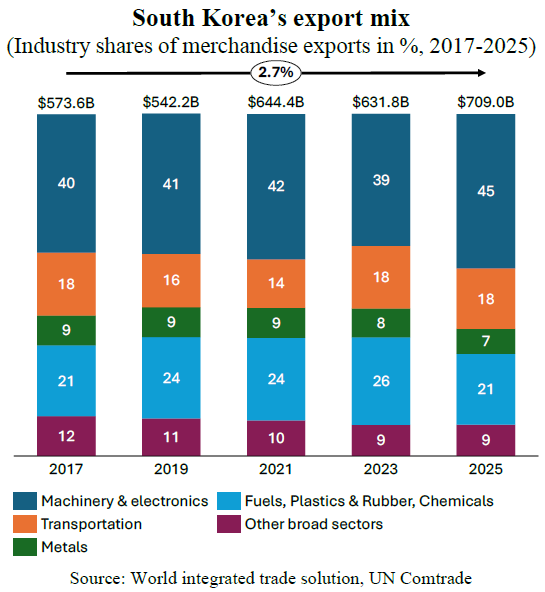
South Korea’s trade story in 2026 is ultimately one of remarkable adaptability. Record export volumes, unrivalled semiconductor dominance, and a landmark security partnership with the United States reflect a nation that has consistently turned challenge into opportunity. The shift away from China dependence, once seen as a vulnerability, is accelerating the development of new and more diversified trade relationships across Southeast Asia and beyond. The emergence of a world-class defence export industry has opened an entirely new revenue stream that few would have anticipated a decade ago. South Korea enters the next phase of global trade not as a passive participant buffeted by forces beyond its control, but as an active architect of new partnerships, new industries, and new strategic alliances. Its ability to supply the world’s most critical technology at scale, while simultaneously building the security and trade relationships that will define the next decade, positions it as one of the most dynamic and consequential trading nations in the global economy today.
Download the PDF version of this weekly commentary in English or عربي